Robot observability platform
AI-Powered RobotObservability and Security
Know what every robot is doing. And why.
One operating picture for fleet health, physical context, incident investigation, action lineage and continuous reliability improvement.
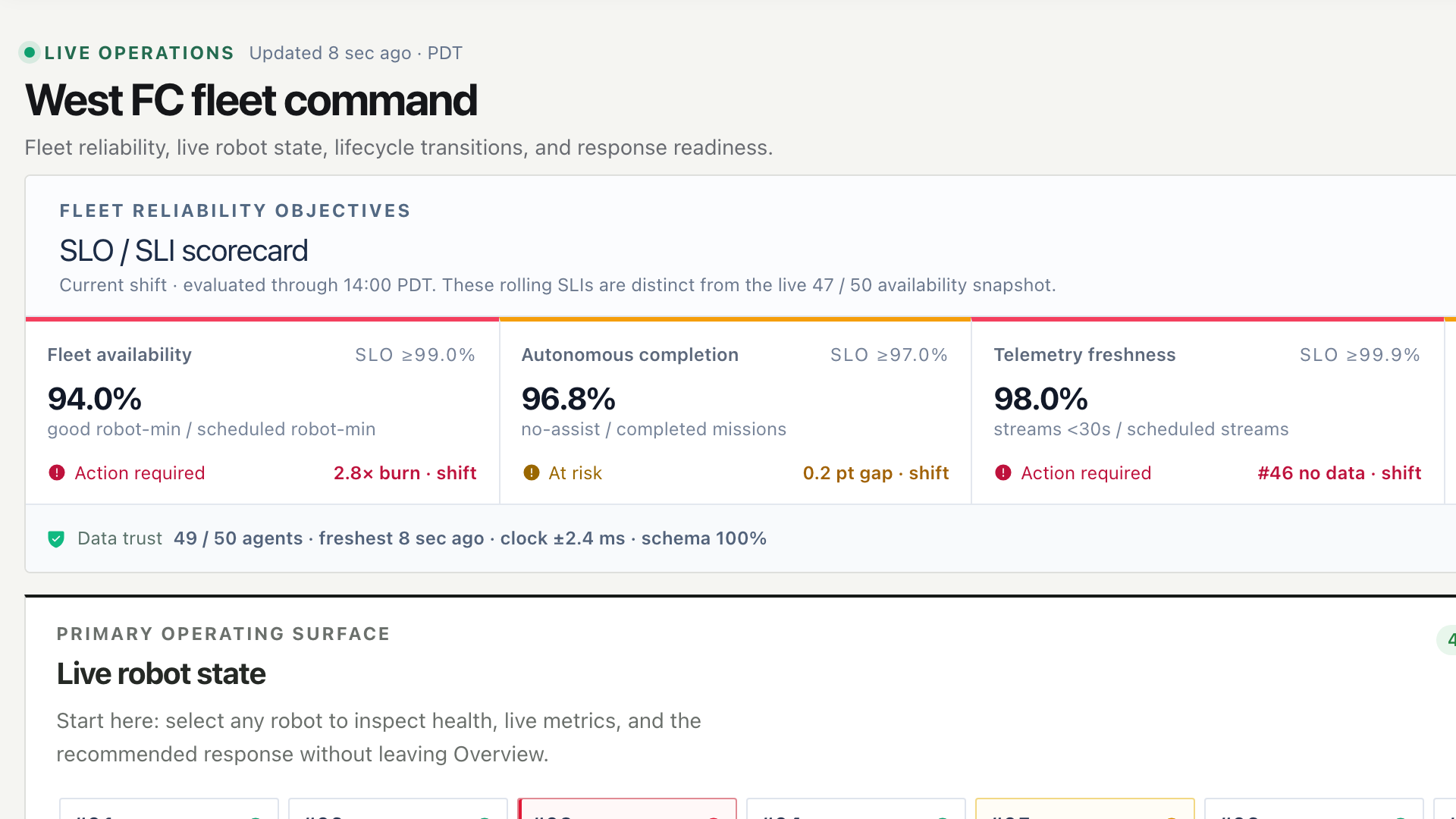
Illustrative West FC product environment · deterministic fleet data
Why robot observability
Autonomy changes the failure surface.
A server failure stays inside software. A robot failure moves through software, hardware, space and safety—while production keeps running.
A failure is never one signal
Physical incidents span actuators, control software, perception, network conditions and human intervention. Separate tools hide the causal chain.
Multimodal failureNo data can be more dangerous than bad data
Stale heartbeats, clock drift and dropped telemetry can make a fleet look healthy while robots are already degrading or offline.
Data trustEvery action needs identity and lineage
At fleet scale, teams must know which operator, policy, model and robot agent initiated an action—and whether it stayed inside the safety envelope.
Security contextOne failure should protect the whole fleet
Verified causes must become cohort risk, targeted data collection, regression evaluation and guarded releases—not disappear inside a closed ticket.
Reliability flywheel10 robotsOperators can still rely on direct observation.1,000 robotsEvery exception needs trusted telemetry, ownership and an auditable response.
One operating systemFrom fleet-wide signal
From fleet-wide signal
to physical cause.
Software observability explained servers. Wichz explains robots—across hardware, software, behavior, safety and the physical world.
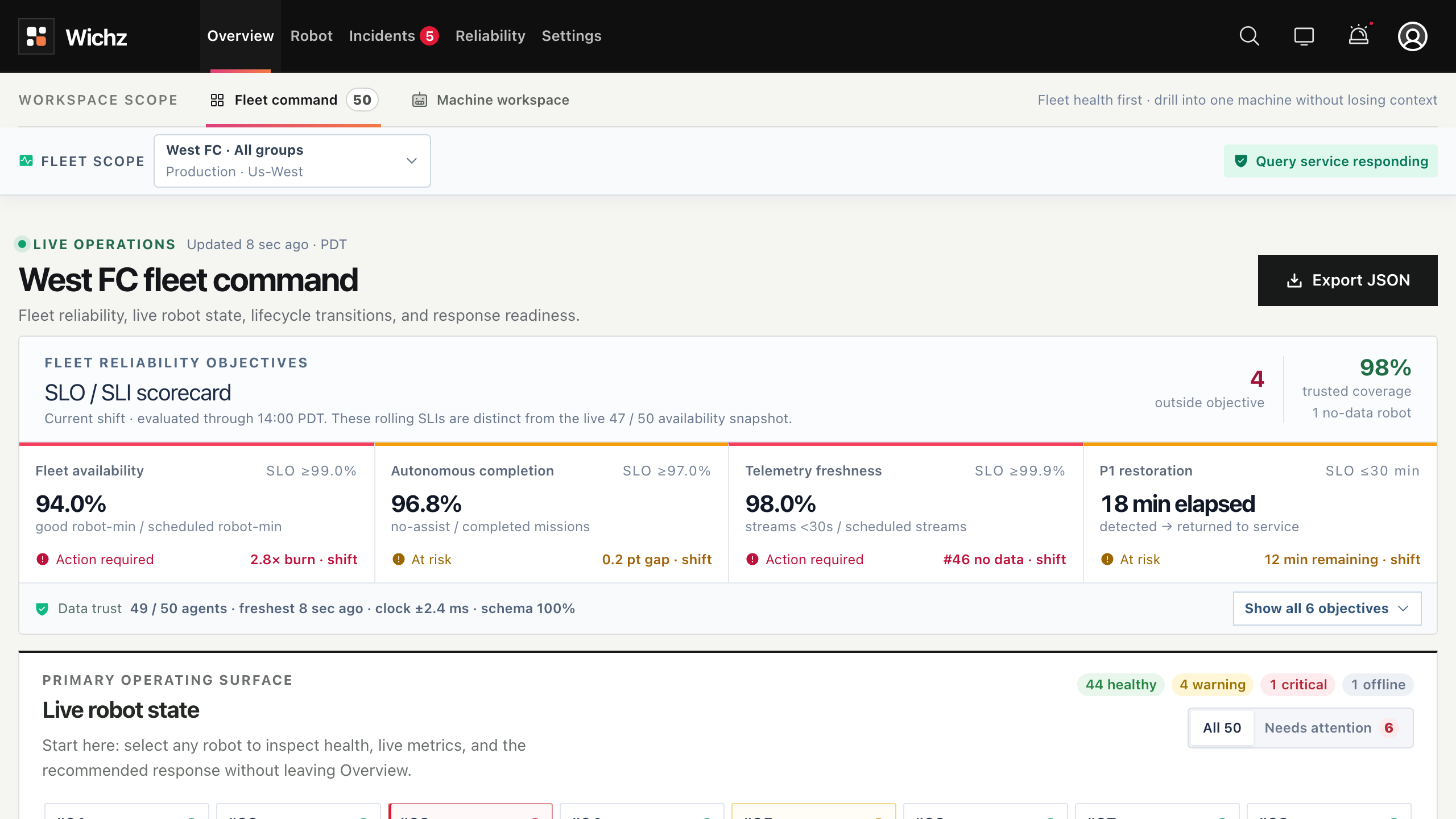
01Fleet health
See the robot that needs attention before throughput slips.
A live operating picture for every robot, mission and reliability objective. Healthy robots stay quiet. Exceptions carry the context needed to act.
- 50 robots
- illustrative fleet health model
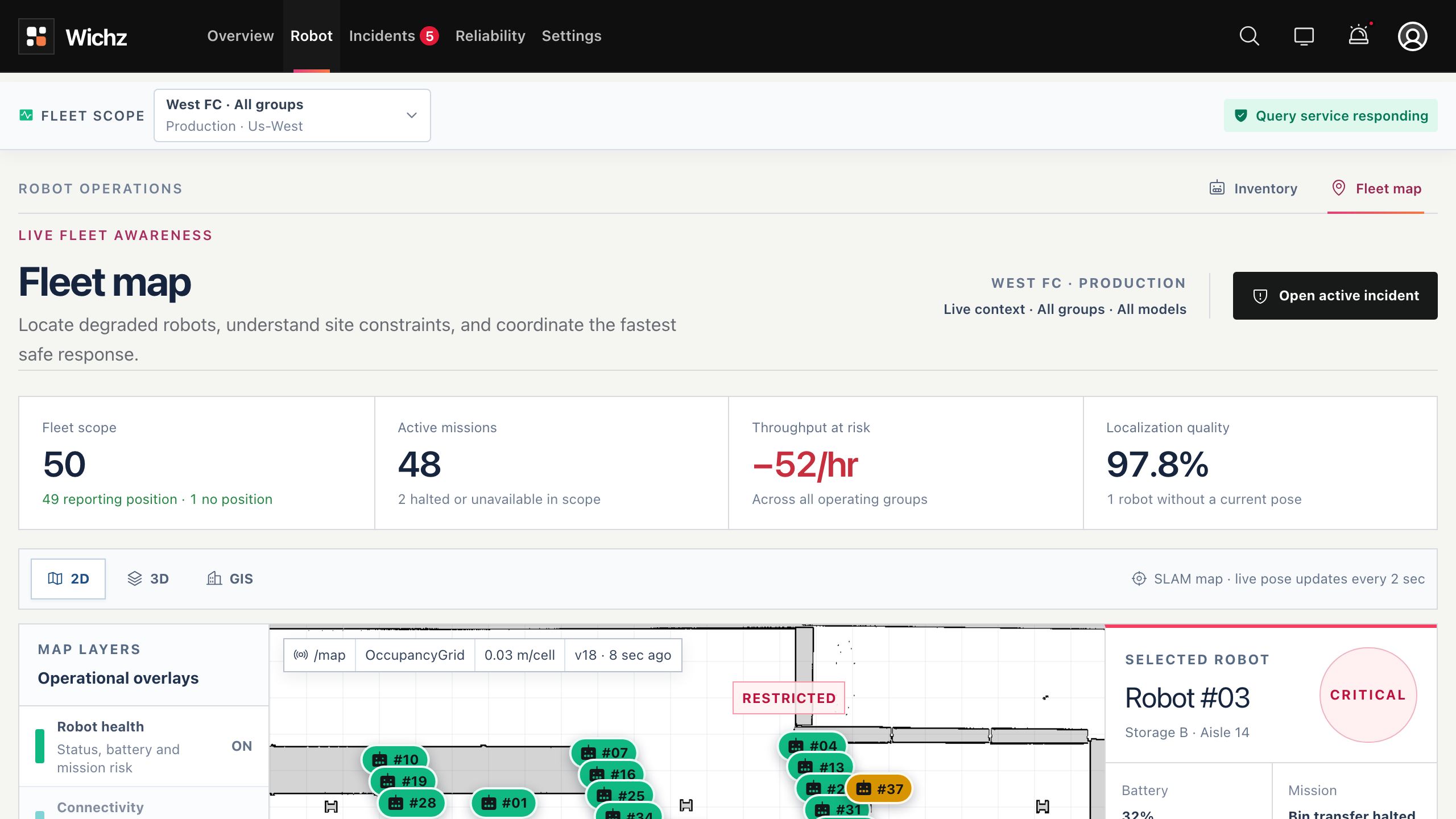
02Spatial awareness
Put every health signal in its physical context.
Use the robot-generated SLAM map to understand position, congestion, restricted zones and nearby fleet risk—without switching to a separate mapping tool.
- 2 sec
- target pose freshness
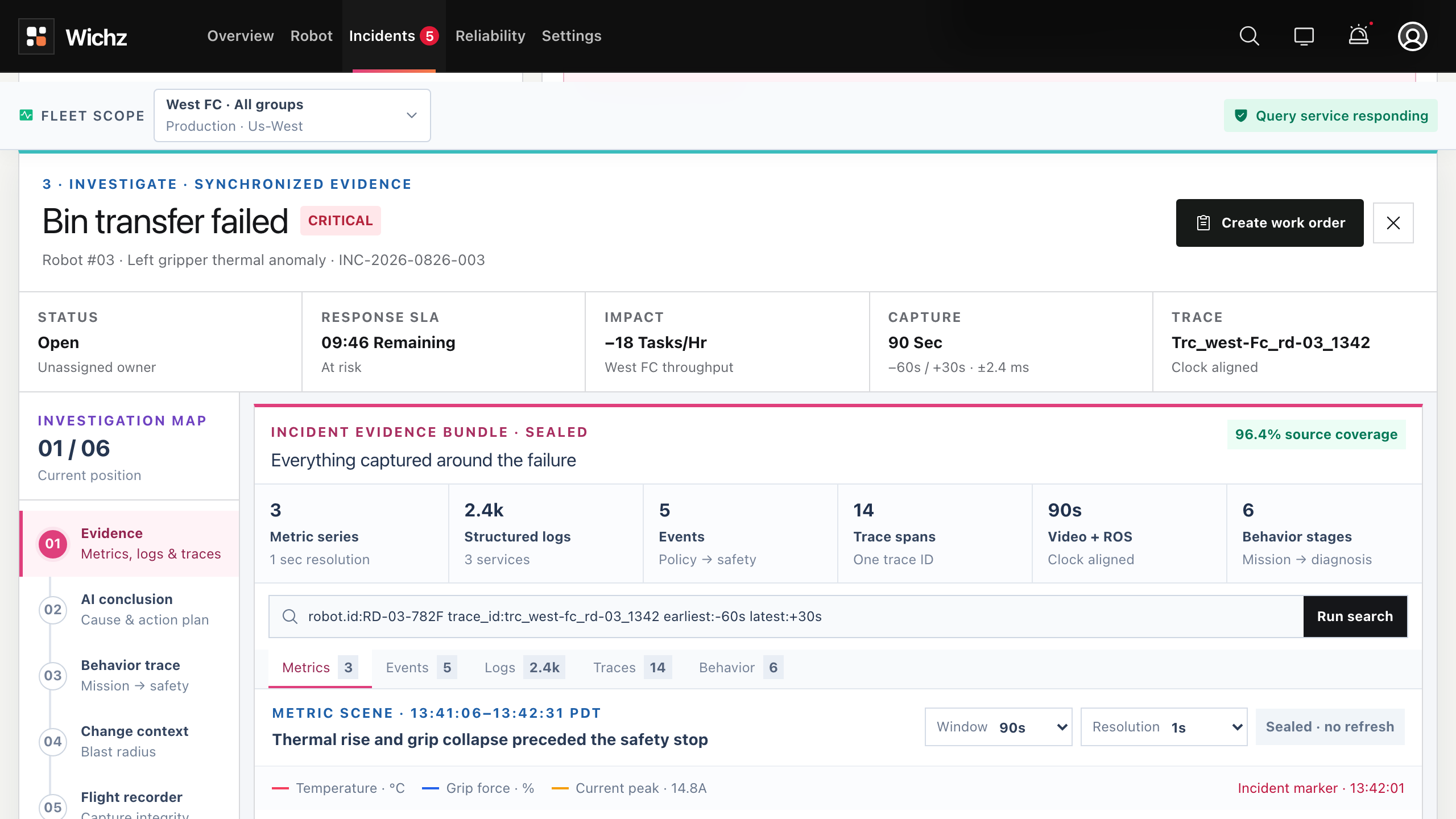
03Incident investigation
Reconstruct the exact moment a physical system failed.
Metrics, logs, traces, video and behavior stages are sealed into one clock-aligned incident bundle. AI proposes the root-cause chain; operators retain the decision.
- 90 sec
- synchronized flight recorder
04Reliability loop
Make every verified failure improve the next release.
Connect repair outcomes to coverage gaps, targeted datasets, regression evaluations and guarded canaries. Reliability work becomes a compounding system—not a ticket archive.
- 12 scenarios
- failure-targeted regression suite
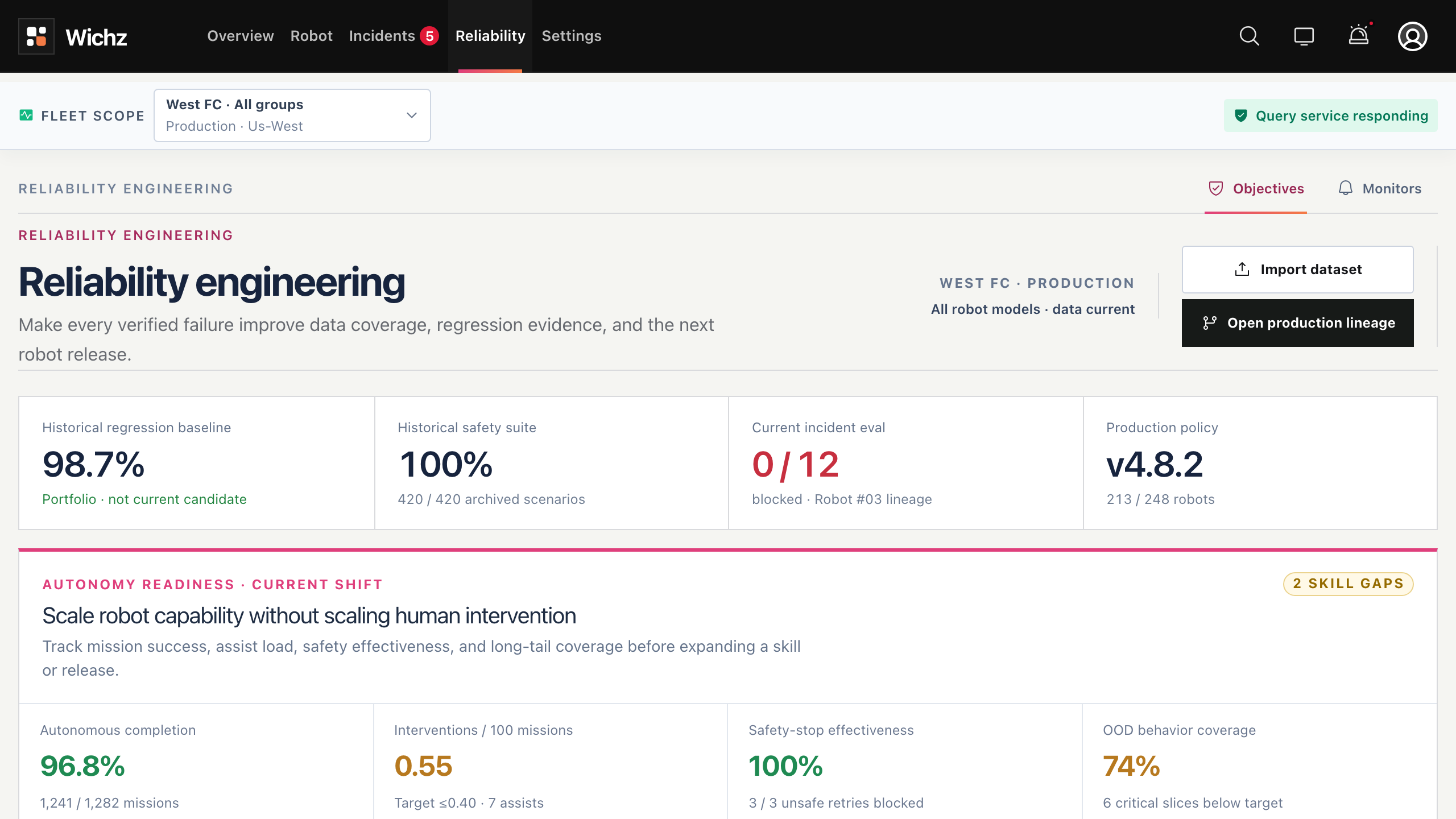
Robot reliability engineering
One continuous response loop.
Every step stays connected to the same robot, incident, evidence bundle and operational objective.
- 01DetectMonitor fires
- 02TriageImpact ranked
- 03InvestigateEvidence sealed
- 04DiagnoseCause linked
- 05RepairSafety gated
- 06ImproveEval and release
Full-stack observability
Built for the systems that move.
Wichz joins operational telemetry with physical evidence and verified outcomes, so each team sees the same truth.
Robot-native telemetry
Battery, actuator, control-loop, localization, mission and safety signals in one model.
Robot-nativeBehavior traces
Mission → policy → command → sensor response → safety intervention → diagnosis.
Robot-nativeFlight recorder
Clock-aligned metrics, logs, traces, ROS events and video around every incident.
Robot-nativeBounded AI diagnosis
Evidence-linked root-cause hypotheses, confidence, short-term response and long-term prevention.
Robot-nativeService restoration
Work orders, isolation gates, recovery checks and explicit return-to-service approval.
Robot-nativeReliability data loop
Convert verified failures into collection briefs, datasets, evals and guarded releases.
Robot-native Observability meets securityKnow what changed.
Know what changed.
And who was allowed to change it.
Human identity, robot-agent credentials, policy decisions, remote actions and safety interventions share one evidence trail—from request to verified result.
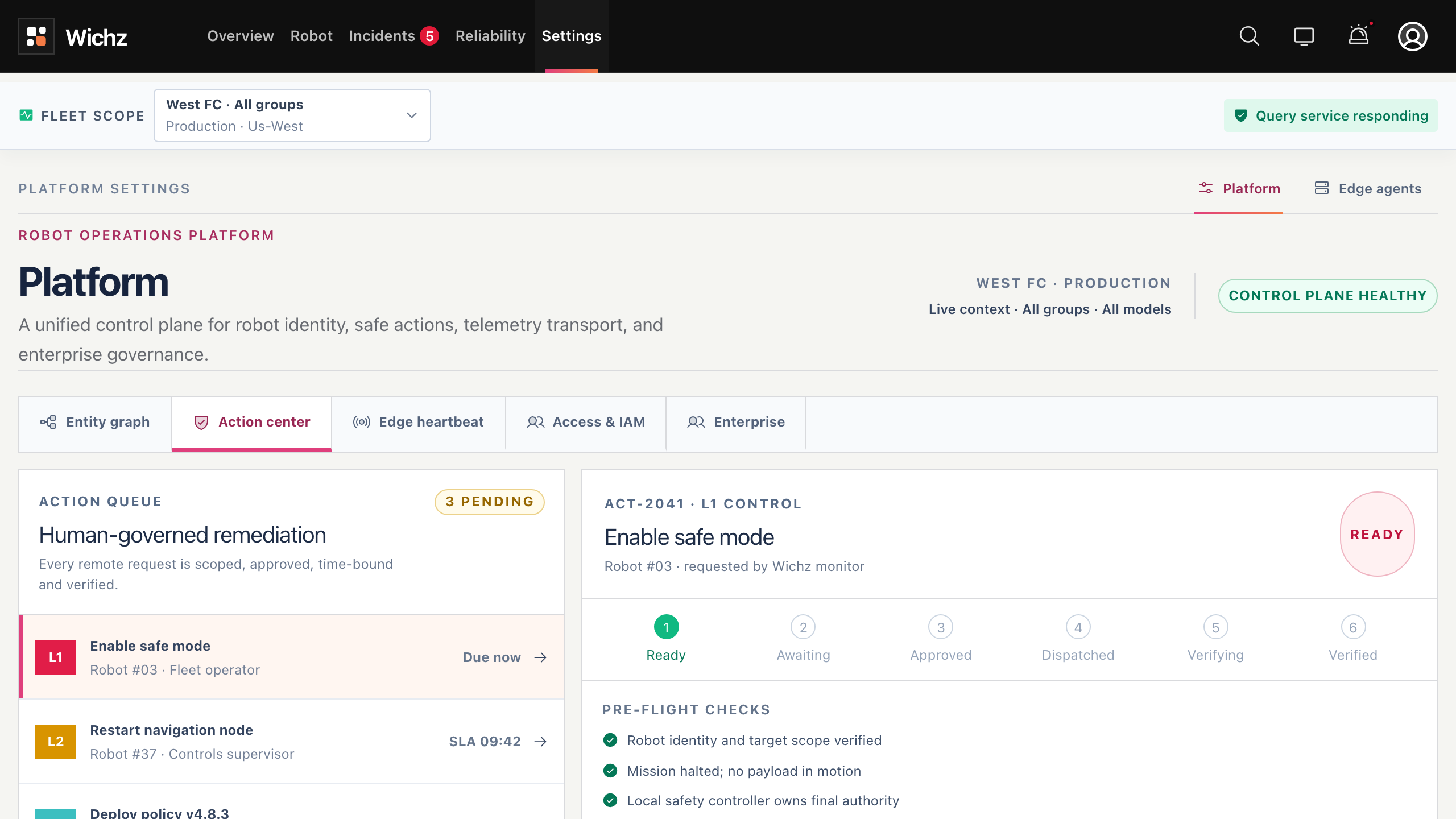
Robot and human identity
Bind every operator, service account and robot agent to one tenant, site, fleet and auditable credential.
Identity-boundPolicy-gated actions
Evaluate scope, permission, robot state, safety preconditions, approval and execution TTL before dispatch.
Default denyAction lineage
Preserve who—or what—requested an action, which policy allowed it, what changed and how the result was verified.
Evidence-linked Production reliabilityOperate every robot
Operate every robot
with confidence.
Detect the exception. Understand the cause. Coordinate the response. Prove the fleet is ready to return.
Review your fleet architecture, telemetry coverage and incident-response workflow with the Wichz team. Wichz
Wichz